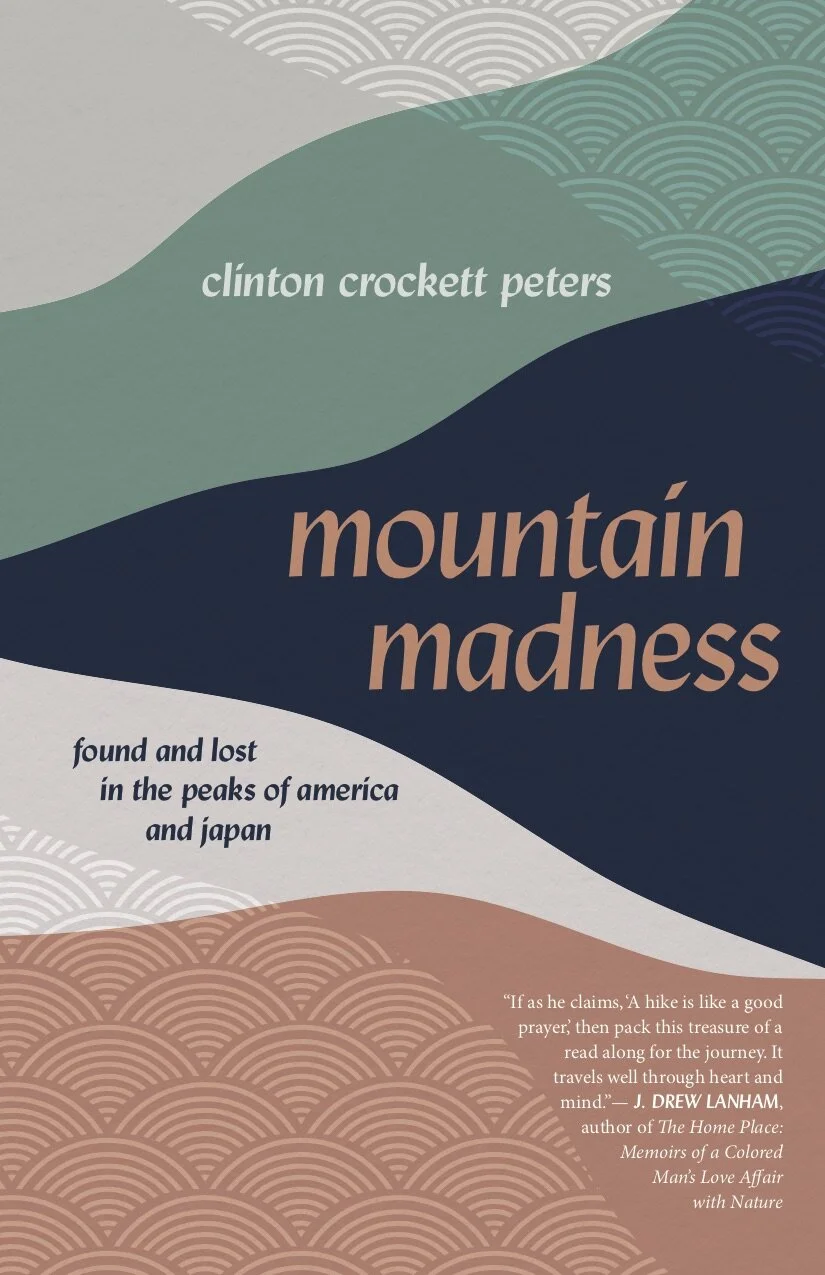
Mountain Madness: Found and Lost in the Peaks of America and Japan
Arriving March 1, 2021, from the University of Georiga Press, Mountain Madness is an essay collection that covers an experience, from 2007 to 2010, when I lived in Kosuge Village (population 900), nestled in the Chichibu Mountains of central Japan. My essays will use these three years as a frame to investigate how landscape affects identity, specifically spiritual and environmental beliefs. The book will profile who I was before Japan (an evangelical and then wilderness guide), why I became obsessed with mountains, and the fall-out from mountain obsession to a humanistic outlook.
The path my narrator takes is one of a mountain hike. I was born in table top-flat West Texas to conservative, Christian parents in the second most Republican county by votes in America. At 19, I made my first backpacking trip to the San Juan Mountains of western Colorado and was awed by their outer-planetary-like massiveness. Two friends and I became lost, off-trail for three days. During this time, an obsession possessed me as we wandered our way through the peaks to safety, a realization that I could die out there, yes, but amid previously unknown splendor. I developed an addiction to mountains that weakened my religious faith. Like the Romantic poets before me, God transferred from the sky to the immense landscape. I jettisoned my beliefs and became an outdoor wilderness instructor. On every peak I traveled up, I hoped to recreate that first conversion experience when I was lost in the woods.
After college, while teaching English in Kosuge Village, I learned about the mountain-worshipping religion Shugendo: a mixture of Buddhism, Shintoism, and Shamanism. I climbed dozens of peaks, spending several days backpacking. However, while in Japan, I was nearly fatally injured on a solo, month-long hike. I saw the accident as a warning and turned my attention to studying writing and literature. When I came to Japan, I went up mountains, but as I left, I came down. The book profiles my experiences with mountains and my double disillusionment, leveling off with a humanistic outlook, leaving the narrator less a wanderer but more willing to empathize with other people.
The title chapter of the book has received the Torch Nonfiction Prize from Crab Orchard Review. Other chapters are published in Hotel Amerika, Catapult, Green Mountains Review, Yemassee Journal, ISLE, and Superstition Review. One chapter, “Giving Fire” was a finalist for contests at Arts and Letters and Phoebe. Another chapter, “Love in the Valley of Death,” was also a finalist for a contest at Arts and Letters.
Quisque iaculis facilisis lacinia. Mauris euismod pellentesque tellus sit amet mollis.