The Texas Snow Monkeys
Humans are 99.4% Chimpanzee. Genetically, we are as close as horses are to donkeys. Switch a few alleles, cross over a few molecules on the circumambulatory ticker tapes of DNA, and we could donate blood, pour our hearts out into the creatures that swing from trees and thump their chests.
Macaques are only 93% chimpanzee, not quite the humanoid doppelgängers. They are naturally shyer than chimps but quickly learn mischievousness. Macaques are the primates you hear about stealing bananas off of card tables in Bangkok, puncturing juice canisters for refined nectar in Bali, and, in one bizarre case of ironic justice, knocking the very man off his balcony in India who was the politician vying for their extermination.
Their hijinks and grunts sound vaguely human (and which is why NASA used them in the Mercury Space project), but if we could imagine them to be people, they would be a very specific breed of homo sapiens sapiens. They are rugged enough to live in almost every climate on four continents, independent enough to walk upright and into the fortified home of their worst enemy, fiendish enough to get what they want when you try to take it away.
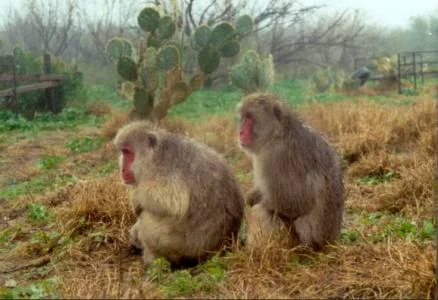
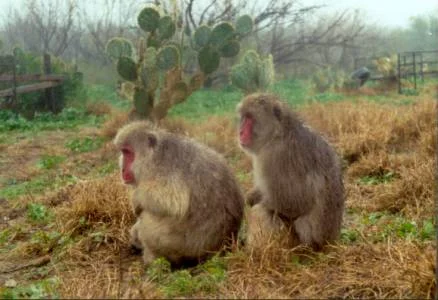
Macaques, I believe, are the Texans of the primate world. And this is probably why, though they are not native here, several hundred macaques have been moved, taken up residence, developed a taste for cactus, and become scorned and hated and hunted in the great misunderstood universe of the Lone Star.
*
Their story begins in central Japan, the cornucopia of acacia trees and vermillion maples, the thick buzz of cicadas and the rolling backs of ancient hills like a reflection, one behind the other into the haze. Tropical storms disgorge their salty mists offshore and blow in curtains of rain that leave behind their perpetual dew and mud. This is the Japan you won’t hear about, the seventy percent of the country blanketed in mountains and forests. So thick is the vegetation, until 1948, a 30-member macaque troupe went undocumented near the outskirts of Kyoto, a million-membered metropolis that happens to be Japan's center for primatology.
But the mountains can get blizzardy in winter, and this is why ninhonzaru are called snow monkeys by the English-speaking world. They are often photographed soaking in hot springs with a bed of powder around the geothermal pools and lining their lips frothily. Some tourists will elect to swim in the hot-springs, share a bath with a naked primate. An interesting example of what postmodern theorist Donna Haraway calls “contact zones” of species mingling. “To be one,” Haraway writes, “is always to become with many.” To bath is to be childlike with the animal again.
Scientist Eiji Ohta discovered the Kyoto troupe accidentally in 1948 while looking for tree frogs. Hiking off-trail amid the foggy summer heat, Ohta was startled by an aggressive, guttural barking, piercing from the brush. Knowing there were Asiatic black bear around, he recoiled and unsheathed a sickle-like knife common among Japanese woodsman. As he backed away, he watched a fury, amorphous blob jump from the rustling bushes and scamper up a trunk. Macaques are known as “semi-terrestrial” in scientific parlance because they spend so much time in trees.
Ohta moved on, escaping into the growth. Moments later, his neck and face cascading with sweat, he looked up while toweling off to see a pair of yellow eyes darting from the shade. Ohta realized these were the macaques he'd heard about as a child. They’d held mythic status in his home town, a story the boat men would tell as they punted downriver. Monkey legends were the East’s version of trickster foxes, sly rabbits, and rascally wolves. Primatologist Frans De Waal believes the presence of monkeys in story and forests has given Asia a better mirror to recognize ourselves. He writes, “Seeing primates makes it hard for us to deny that we are part of nature.”
Forgetting his fear, Ohta thought he might be able to catch a macaque, drag him and drug him or knock him unconscious with a big stick. He took to awkwardly climbing the branches where the macaque sat stilly examining him. After Ohta struggled for thirty minutes, the macaque neatly jumped from his branch to the understory of another tree and from there dropped to the ground and disappeared from sight.
“The figure of that monkey,” Ohta wrote, “filled me with a mysterious feeling of wonder.”
*
Ohta clued in his colleagues at Kyoto’s university, who began leaving out food, drawing the macaques to an open area. After several months, the scientists lured the troupe to a location for a safari ranch-like monkey park, a convenient drive from the city and a way to pay for their research.
In postwar Japan, after the leveling of the country, many Japanese were looking for something to pride themselves on. The economy, of course, was the most trenchant purpose, and many threw themselves into the labor machine. But Nihonzaru, “Japan’s monkey,” indigenous and abundant, became a sudden fixation. Over thirty wildlife monkey parks sprung up around the main island in the 1950s. Each researcher at the Kyoto park took to wearing on his chest a large white apron dyed in the center with a giant red dot, a simulacrum of the Japanese flag.
Gorging on feed, the troupe mushroomed. By 1958, birth rates tripled and the infant survivability rate went from 63 percent to an unprecedented one hundred percent. Individual body sizes bloated. The scientists watched them creep closer, until the macaques grew accustomed to their food and then to their benefactors. They morphed away from a ghost story told on the river into vegetable stealing tangibility.
Around the mountain and at other parks, Macaques began sneaking into gardens, decapitating cabbage, tearing down fences, pounding on roofs, scaring children. By the late sixties, national interest waned, and some humans took their revenge. The Kyoto troupe lost three Alpha male leaders in succession, all to human hunters.
Then the valley forest was cut to make paper and room for postwar sprawl. A power struggle emerged, and the macaque troupe split. The dominant monkeys held the mountain and the park, while the losers descended into what was left of the valley. With little space to make their homes, the monkeys rooted in cellars, stole from farms, broke into and pissed on shrines.
One Kyoto professor, knowing the macaques would soon be exterminated, on chance, asked a visiting American colleague, “Would you be so kind as to accept one of these groups as a gift?”
Lacking indigenous primates, the American thought having a stable troupe within easy observation would be a boon to publishable understanding. He and other scientists began meeting to discuss immigration. They wanted their host site to be hilly and forested as Kyoto is. The new home needed an enclosure to prevent escape. It needed to be cool, but not too hot because the “snow” monkeys cannot sweat. The primates needed to be within easy access of a major university and be outside local disturbances such as mining, agriculture, and drilling. An island off the coast of Georgia would do. Or Hawaii.
After two years and a Jurassic Park-like Macaque Island not forthcoming, the scientists’ talk turned practical. They found a wealthy rancher named Edward Dryden, who offered to house, fence, feed, and maintain the macaques for no charge at his ranch in Texas. Dryden’s bargain was he would sell off the “excess” of the troupe on the animal testing market. And so a few macaques would live confined in cages, try on makeup, swallow pharmaceuticals, undergo deadening brain surgery, and, in turn, an entire population would be provided for in their new home.
*
“Revolutionary” confinement, like the prison system of Pelican Bay, California, writes sociologist Zygmunt Bauman, is where inmates are kept totally isolated from contact. The revolutionary aspect is that there is no need, because of a system of doors and locks and windows, for prisoners to speak, touch, or interact with anyone at all.
“No wonder,” Bauman writes, “the victims mount a defense... prefer to reject their rejectors.”
Twenty years later, Texas snow monkeys would move to the Born Free Primate Refuge, a monkey shelter that rescues simians from laboratories. Primates raised in confinement, grow up biting themselves and sometimes attacking their owners. They go, clinically, crazy. They become dangerous as one 55-year-old woman in Connecticut found out when a confined pet chimp named Travis escaped his cage and ate most of the woman’s face and hands.
Likewise, Texans resist confinement. From Mexico. From gun laws. From healthcare. Even today, a vocal minority believes the state is a sovereign nation. Many of their fellow citizens are Mexican-American, are locked up on death row, are subject to bad health. They are held in a different jail, and some of them, too, resist.
*
Capturing the macaques in Kyoto began in February 1972. 152 were lured into cages with bait and then they were loaded onto a Japan Airlines cargo flight. One monkey died en route, and another lost a toe.
They arrived in the blinking light of Laredo near the Mexican border. Released, they pattered around the bunkers of cottontails. Surrounding them were road runners, timber rattlesnakes, tarantulas, bob cats, armadillos, javelinas, and more than one hundred species of cactus. They were encircled by a ten thousand foot long fence that was electric and eight feet high. A few of the monkeys grabbed the wires and locked on, the volts pulsing through their fur, and attending researchers had to dislodge them.
Laredo is eight degrees closer to the equator than Kyoto. It has high temperatures regularly over a hundred. In their first summer, the macaques ate coyotillo berries, which contain a lethal neurotoxin and no antidote. A few monkeys were dragged from their enclosure by bobcats and eaten. Some were bitten and killed by rattlesnakes. More than a few contracted screwworms. Dozens were devastated by what’s known as “valley fever,” a fungus inhaled directly from the alkaline soil.
They were surrounded by sand, predators, barbed wire, and an environment as hostile and unfamiliar as a desolate moon. Within the first two years of Texas living, half of the wayward troupe had died.
*
By the late seventies, after six years shaded under mesquite trees, toiling on bare soil, eking out a living in the Laredo sun, the snow monkeys of Texas adapted. Scientists observing the troupe found it easier to note what floral the monkeys didn’t try consuming. Cactus became a troupe favorite, especially the succulent flower bulbs. The macaques took to climbing prickly pears, deftly clinging between the spines and ripping off new-grown pads and eating them like potato chips.
Over the next two decades, the troupe’s numbers swelled to five, then six hundred. Generations of macaques were born on Texas soil. They became bilingual. The troupe developed a warning bark for rattlesnakes, that when played back home was nonsensical to the old-world.
Yet the Texas monkeys could understand Japanese warnings. They were living in the in-between world of immigrants, both newcomers and initiates to the landscape.
But had they read Zygmunt Bauman they would know that for the “global vagabonds,” pushed out of their homes by modernity, “they won’t stay in place for long, however strongly they wish to, since nowhere they stop are they likely to be welcome.”
*
When the rancher Dryden died, his widow reportedly instructed the scientists to, “Get these stinking monkeys off the property.” She didn’t like, apparently, what Donna Haraway calls “the risk of an intersecting gaze,” of species to species, captor to captured.
Shuttling the monkeys around, the scientists pulled together funds and purchased land outside of San Antonio. But twenty-three acres couldn't contain them. The monkeys dug. They stole. They climbed mesquite branches and delicately lowered themselves onto private property. Macaque males were witnessed climbing the charged fences, even while being electrocuted.
They snuck. They ate up bait and crapped in deer blinds. They clamored on people’s houses. Chewed up porch swings. Killed a dog, allegedly. They broke into houses while people were gone. Scared cattle. Ate cabbage. And laughed.
*
It is no mere cliche to say that Texans love to hunt. There are more guns here per capita than any other state besides Alaska. The only large predator in Texas is the cougar. There are only maybe five hundred in the state, but you can kill as many as you want at anytime.
Soon after hearing complaints of the snow monkeys’ antics, the Texas Department of Parks and Wildlife declared the monkeys an “exotic unprotected species.” An open season on macaques. Deer at least have a time in the year when they can’t be exterminated.
Hunters poured into San Antonio asking for monkey hunting permits, which did not exist. The simians were like a weed that could be uprooted. An undocumented laborer who could be deported.
Just before the scientists argued the monkeys case in Texas legislation, four monkeys were tricked with food into climbing outside an enclosure and were gunned down by a man or men holding shotguns. The monkeys were a family, two of the macaques lactating females. The killers were invariably linked to friends of friends (who some said were Danish), and they were never found.
*
Texas media blared their demise over the ink and airwaves. In death, the macaques became martyrs. Grandmothers decried the deed. Wayne Newton, when hearing the story, flew to San Antonio to sing a concert, raising money for the troupe. He cried when he broke from song to talk about the slaughtered.
The scientists successfully argued their case, and the Texas government ruled that the monkeys were not invasive but livestock. Cows cannot be tricked and shot, although they are Turkish in origin and will occasionally roam the countryside damaging cars and mailboxes. Under Texas law, Penal Code Sec. 9.42, a Texan is authorized, “using deadly force against another to protect land or tangible, movable property.”
Horses were once eradicated from North America, but it is now legal to shotgun someone who wrangles an imported stallion. Pigs are from China, as are chickens. Similarly, you can’t, without payment, hunt one of the nearly 200 species of exotic African or Asian game that live on safari ranches throughout Texas. These animals were brought over for zoos, originally, and when the menageries went bankrupt, the animals were turned loose across the countryside. They trespassed, but landowners realized many fellow Americans would pay good money for a safari they could only find in Africa. So, for the price of a brand new Audi, you can scope and snipe a cape water buffalo or saw the horns off a dead scimitar oryx, that later which has gone instinct in its native home in the Sahara.
The elite’s wet dream, Zygmunt Bauman writes, is if one day all the poor of the world, all the vagabonds and huddled masses and undocumenteds, slip sharply and stealthily into the good night. The world, he notes, is becoming a penal system, or, if you include animals, a Safari ranch.
But we’ve never been good jailers. Life slips out, through, into the night, under the walls, up the referendums of politicians and scientists. Life rejects corralling. Animals and humans exist, like the prisoners and the guards, mirroring each other.
Seeing primates reminds us of who we are, a look across the geothermal pools at our fellow bathers, a look across borders. As Derrida wrote, “The animal looks at us, and we are naked before it.”
It is only when we own something, like the grandmotherly grins of old livestock, that we let it be something to us, that we save it legally. But salvation is more than a term, it is about being comfortable, becoming with ourselves.
*
After the macaque family was gunned down, retired hall-of-fame pitcher Nolan Ryan espied a scurrying simian on his ranch in South Texas. Confused as anyone who didn’t know the immigrants’ story, he asked around. When Texas Parks and Wildlife learned that Ryan, the “Express” himself, was interested, they appointed him to be their delegated “snow monkey ambassador.” The monkeys were still a nuisance across the Hill Country, and Texas Parks thought that Ryan, one of the most famous Texans, could help with the monkey trouble.
In 2008, he appeared on a much listened-to sports talk show “The Ticket.” A taped conversation reveals a bewildered Ryan retelling his first encounter at the refuge. Driving in among the mesquite and cactus, Ryan heard a rattling on the car’s roof, and then the hood. Soon the vehicle was carpeted with what he describes as thousands of monkeys, crying, squealing, jumping, and pounding.
“It's kind of like one of those things you see in Africa,” he says. “I reluctantly got out and... one of them jumped off the top of the truck on my shoulder and was hanging on me. And I didn't know what to do. I was like petrified wood.”
Eventually, with the aid of Hersey’s Kisses, Ryan won over the macaques. Then scientists won over Ryan that education was key, that people didn’t know why the monkeys were here, why they were forced out of their homes, why they had to adapt and respond to the harsh life they had found. And thus, the hall-of-famer, a man with a world-record 5,714 strikeouts, became their champion.
*
The culmination of Ryan’s advocacy was a series of Ranger games in which the ball team gave away thousands of gray, stuffed furry dolls with twinkling eyes to spread awareness. July 1, 2012 was the first official “Nolan Ryan Snow Monkey Day” in Rangers Ballpark in Arlington. The first 10,000 children, ages thirteen-and-under, got a free monkey. The fans were asked to hold up their livestock at break, high into the noon light as everyone in the stadium stopped what they were doing.
10,000 children held up their gifts, which, from far away, if you didn’t argue with yourself, looked like infants gazing into the sun.
















Quisque iaculis facilisis lacinia. Mauris euismod pellentesque tellus sit amet mollis.