• Essays
  • Longform Journalism
  • Fiction
  • Pandora's Garden: Kudzu, Cockroaches, and Other Misfits of Ecology
  • Mountain Madness: Found and Lost in the Peaks of America and Japan
  • Author Interviews BY Me
  • Book Reviews BY Me
  • Author Interviews and Reviews OF me
  • Contact
  • About
Menu

Clinton Crockett Peters

Street Address
City, State, Zip
Phone Number
Writer

Your Custom Text Here

Clinton Crockett Peters

  • Essays
  • Longform Journalism
  • Fiction
  • Pandora's Garden: Kudzu, Cockroaches, and Other Misfits of Ecology
  • Mountain Madness: Found and Lost in the Peaks of America and Japan
  • Author Interviews BY Me
  • Book Reviews BY Me
  • Author Interviews and Reviews OF me
  • Contact
  • About

Talking with Clinton Crockett Peters by Elizabeth Cook, Carve

https://www.carvezine.com/from-the-editor/talking-with-clinton-crockett-peters

A beauty of essays, which is what I tend to write, the lineage I follow (Montaigne, Sei Shōnagun, Yoshida Kenko, Lia Purpura), is that chaos is meaningful. I love narratives, but the mind doesn’t work like that. Few people narrate their day. The brain doesn’t process chronologically; it’s a jumble of ideas, memories, fleeting cravings, and scattered conversations that are sometimes imagined. So that tension that you point to is, in fact, perfect for the essay form. Essays try to make sense of something baffling; they chew on an idea until it is digestible. Sometimes it doesn’t end well. Sometimes, essays fail. A mystery remains, while at the same an essay succeeds at creating resonance. There is no way I have here made sense of the chaotic aspect of existence—that nothing, ultimately, goes to plan despite what we tell ourselves. However, that feels human, doesn’t it?

Didion famously and enigmatically wrote “we tell ourselves stories in order to live.” Maybe, if entropy is the other side of life—the embracing of inevitable chaos—we write essays to help us die…
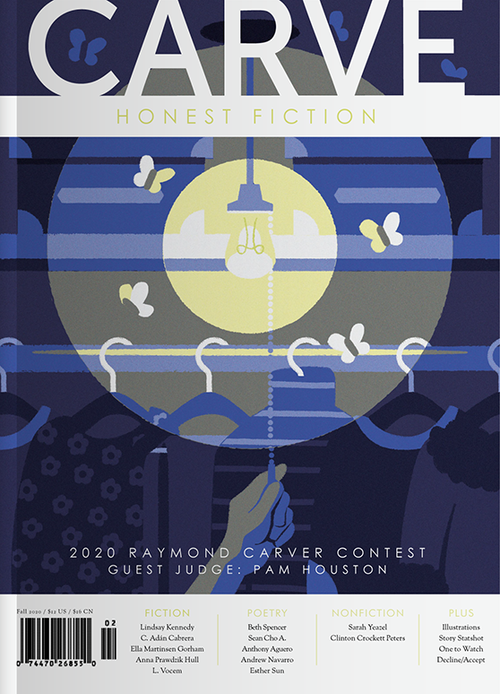
Talking with Clinton Crockett Peters by Elizabeth Cook, Carve

https://www.carvezine.com/from-the-editor/talking-with-clinton-crockett-peters

A beauty of essays, which is what I tend to write, the lineage I follow (Montaigne, Sei Shōnagun, Yoshida Kenko, Lia Purpura), is that chaos is meaningful. I love narratives, but the mind doesn’t work like that. Few people narrate their day. The brain doesn’t process chronologically; it’s a jumble of ideas, memories, fleeting cravings, and scattered conversations that are sometimes imagined. So that tension that you point to is, in fact, perfect for the essay form. Essays try to make sense of something baffling; they chew on an idea until it is digestible. Sometimes it doesn’t end well. Sometimes, essays fail. A mystery remains, while at the same an essay succeeds at creating resonance. There is no way I have here made sense of the chaotic aspect of existence—that nothing, ultimately, goes to plan despite what we tell ourselves. However, that feels human, doesn’t it?

Didion famously and enigmatically wrote “we tell ourselves stories in order to live.” Maybe, if entropy is the other side of life—the embracing of inevitable chaos—we write essays to help us die…

Cover+Image+Large.png
Summary Block
This block is invalid. Please check the block settings and try again.
Featured
Aenean eu leo Quam

Powered by Squarespace