The Great Story of the Stinking Cedar in the Garden of Eden, Southwest Review Vol. 102, No. 1
www.smu.edu/SouthwestReview/CurrentBackIssues
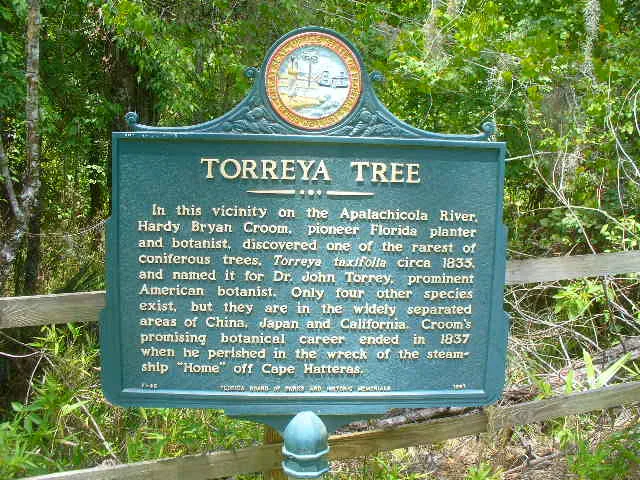
"The Florida torreya, known as the stinking cedar, is a 165 million-year-old yew species that is older than the Tyrannosaurus rex. It is older than tree sloths, alligators, whale sharks, and bees. It is older than the Bering Sea, Hawaii, half of Australia, and the dwarf planet Pluto.
It is called “stinking” for the musk of celery, tomato, and turpentine that waffles to your nose when you sniff its needles. Its seeds, after they fall, also have the uncanny ability of mimicking mammalian sewage. The evolutionary theory is that the seeds were consumed by roaming, Paleolithic giants, carried in the gullets of mastodons and spectacled bears and giant sloths, spread to new homes upon digestion.
One ecologist estimated that there were 600,000 stinking cedars in Florida before the twentieth century. By 1950, most were harvested for fence posts, shingles, and Christmas trees.
Stinking cedars perfumed bungalows. Shingles kept living rooms warm while stinking cedar planks fenced and guarded yards. Children unwrapped presents scented with turpentine. The trees wove in and out of Floridians’ lives, creating the bulwark for the passage through time.
Minus colossal, Paleolithic carriers, hunted out by early Americans, stinking cedars are restricted to where their golfball seeds fall. And because of climate change, a pathogen previously unknown to science is slaughtering torreya newborns. And the warming planet’s heat laps at their branches, the once vermillion needles shading to the color of rust.
With all these changes there are as few as 600 stinking cedars left in the world. It is one of the oldest and rarest of Earth’s living things.
Some humans are constructing a lifeboat for the creature, an exodus from the extinction we’re causing. This journey may carry us away into a different story about our relationship with nature, a story with several characters, one that heralds the death of Eden and doesn’t mourn."
Quisque iaculis facilisis lacinia. Mauris euismod pellentesque tellus sit amet mollis.